San Andrés in Tenerife: new wine, chestnuts and rattling cans
On the night of 29 November, northern Tenerife opens its cellars, tastes the new wine and drags cans through the streets. What San Andrés is and how to join in.
26 October 2026
My earliest memories of San Andrés have no wine in them. They have woods. Late 80s, the whole family heading up the hill to gather chestnuts.
I’m from Puerto de la Cruz, so the cacharro was part of growing up. We’d head down to Plaza del Charco and the harbour to buy chestnuts from my dad’s cousin, who had her stall there (still there, as it happens), and then run the cacharro round the square: tin cans strung on a length of wire, dragged along as loudly as humanly possible. What really got me were the cacharros arriving from every corner of town. Absolute monsters, enormous things that sounded like someone was towing a car down the street (one or two, I suspect, were half a car).
At home, San Andrés was always celebrated, and always the same way: salt fish, sweet potatoes, and chestnuts roasted in a handmade clay roaster. And my dad turning up with demijohns of red wine. That was the new wine, even if back then I wouldn’t have called it that.
Confession time: I have tasted new wine, but never with my mind actually on it, never clocking that what was in the glass was the first outing of that year’s harvest. That’s what this guide is about. What exactly is being celebrated, why there are kids dragging scrap metal through the streets at the end of November, and what to expect from the wine that comes in a demijohn.
What is San Andrés in the Canary Islands?
San Andrés is the new wine festival: on the night of 29 November, the eve of St Andrew’s Day, northern Tenerife opens its cellars and tastes that year’s wine for the first time, with roasted chestnuts and salt fish on the side.
It’s celebrated hardest in Puerto de la Cruz, the Orotava Valley and Icod de los Vinos, all old vine country in the north of Tenerife. Each town brings its own racket: in Puerto and La Orotava they run the cacharro, in Icod they hurl themselves downhill on wooden boards. Underneath, it’s the same thing everywhere: the harvest is in, the must has become wine, and it’s time to taste it.
La Palma does its own version a few weeks earlier, for San Martín. On the night of 10 November the island opens its casks and tries the new wine, roasted chestnuts included. There’s even a local saying: “por San Martín, todo el vino es bueno”, at St Martin’s, all wine is good. Generous lot, the palmeros.
Running the cacharro: from wine barrels to the Charco
Running the cacharro is exactly what it sounds like: gather tins, old pots, lids, a bathtub if you can find one, tie the lot to a wire and drag it down the street making as much noise as possible. It’s mostly kids, although the parents join in with more enthusiasm than they’d ever admit.
Why? Nobody knows for sure, and the legends are wonderful: to scare off locusts, to scare off witches, because St Andrew was lame and turned up late to his own party, because he overslept and had to be woken with a clatter of tins. The explanation researchers find most convincing is less magical and far more vinous. On the eve of San Andrés, winemakers from the hills would bring their barrels down to the coast to clean them with seawater before the new wine went in, rolling them downhill all the way. The din of those barrels bouncing over the cobbles is what the kids ended up imitating with their cans.
So the cacharro is, essentially, a pretend barrel. I love that.
In Puerto, the heart of it is still Plaza del Charco, a stone’s throw from the harbour, where cacharros from every neighbourhood converge. The festival hit its peak in the late 70s and the 80s (my wire-in-hand years, which finally explains why the cacharros were so beastly) and then faded in a lot of towns. These days it’s kept alive by residents’ associations, schools and the town hall itself, which even hands out cacharros so nobody misses out on the noise.
The tablas of Icod de los Vinos
Icod wins the prize for the most kamikaze version. Nobody drags tins here: they drag themselves. On a greased wooden board, down the steep cobbled streets of the old town, with Calle de El Plano as the star slope. The young ones fly down at full tilt, and how they stop is very much their own business.
The custom comes from the trade: November was the season for felling timber and hauling it down from the hills, and the boards used for hauling ended up as sledges. A 2018 study from the University of La Laguna put the tradition at close to 500 years old, and it’s now a declared Festival of National Tourist Interest in Spain. With a town called Icod “of the Wines”, it was never going to be about anything else: the tablas go hand in hand with uncorking the first bottle of the new harvest.
For 2026, the town hall has announced the uncorking of the new wine on Friday 27 November, the hauling and other events on Saturday 28, and the board descent on Sunday 29. If you’re going, check the official programme first, as times do shift.
What is new wine and what does it taste like?
New wine is the wine from the latest harvest, freshly fermented, with no ageing and no long rest: grapes picked in late summer or early autumn that are ready to drink by November. In northern Tenerife it’s mostly red, made from Listán Negro.
Don’t expect a wine for the cellar, because it isn’t trying to be one. It’s young, fruit first, with lively acidity and sometimes a few rough edges: a bit rustic, the odd quirk a big winery would polish away and a small grower leaves well alone. That’s the charm. It’s the vintage photographed without a filter. If the year was good, you’ll know; if it was bad, you’ll know that too, and nobody’s hiding it.
Young Listán Negro is also best served cool. Not ice cold, but after a spell in the fridge, which is when that red fruit and the faint smokiness so typical of the north come through. (We’ve written a whole guide on the Canary red that changes its face, and new wine is its youngest face.)
Second confession: I’m almost certain my dad’s demijohns were exactly this. Wine from some grower in the north, that year’s harvest, no label, no pedigree. The San Andrés wine of nearly every house in Puerto.
The guachinche: where new wine lives
If new wine has a home, it’s the guachinche. And not a restaurant with wooden tables and “guachinche” on the sign: a proper one, which in the Canaries has been regulated by law since 2013 (Decree 83/2013).
The rules are pretty clear:
- The wine must be their own. From the owner’s vines, made by the owner. If they hand you a list of wines from other producers, you’re not in a guachinche.
- Wine and water only. No beer, no soft drinks.
- Three dishes at most, plus pickles, nuts and local fruit.
- Four months a year, tops, and they close early if the wine runs out.
- The sign by the door reads “vino de cosecha propia” (home-grown wine), with a bunch of grapes and a V on a burgundy background. That’s the official tell. Or, if you’re a proper Clandestino, the hand-painted sign by the side of the road.
That’s why new wine and guachinches go together: a guachinche opens when there’s wine to sell and shuts when there’s none left.
My plan this year is exactly that: salt fish at a guachinche in La Montañeta, with my mind on the glass for once. I’m keeping the name to myself, though. Good guachinches are a closely guarded secret.
If you’ve never set foot in one, our guide on where to start with Canary Islands wine explains why the guachinche is the first rung on the ladder.
The San Andrés table: chestnuts, salt fish and sweet potato
What goes with the new wine is no accident. It’s all seasonal and all of it makes you thirsty.
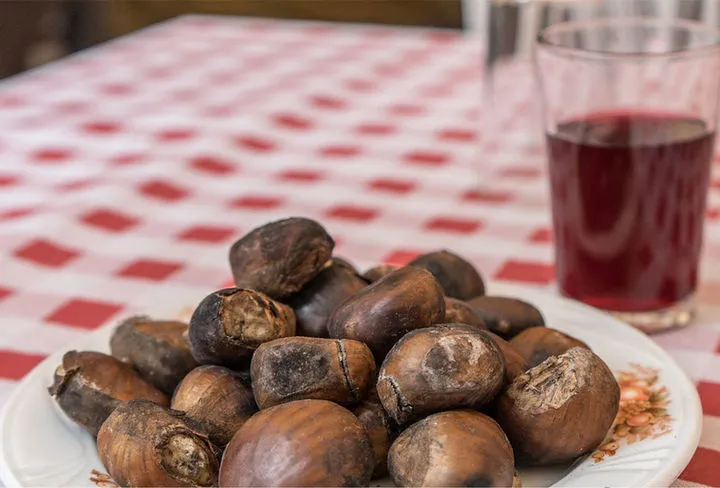
- Roasted chestnuts. They come down from the hills right at this time of year and they’re the smell of the festival. In the street, in a paper cone; at home, out of the clay roaster.
- Salt fish. Sardines or any other fish cured in salt, soaked before cooking. Salt and young red are made for each other.
- Sweet potato and papas arrugadas. Small potatoes boiled in very salty water until the skins wrinkle and frost over with salt, giving everything else something to sit on.
It’s a poor man’s table and a feast at the same time: three or four things, all local, all in season. It suits new wine down to the ground because neither the chestnuts nor the sweet potato ask anything of it, and the salt in the fish brings the fruit out.
How to do San Andrés (even if you’re not in Tenerife)
If you’re in northern Tenerife:
- Puerto de la Cruz, the night of 29 November. Plaza del Charco, cacharros from every neighbourhood and roast chestnut stalls on every corner. Some have been in the same spot for decades.
- Icod de los Vinos, 27 to 29 November. The uncorking, boards down El Plano and new wine in the old town. This is DO Ycoden-Daute-Isora country, which we cover in our Tenerife wine guide by valley and altitude.
- La Orotava. Neighbourhoods like Los Cuartos-San Andrés keep the cacharro going, and the valley has vines to spare.
- A guachinche, any day in those weeks. Look for the hand-painted sign by the side of the road.
If you’re on La Palma: bring it forward to 10 and 11 November, for San Martín.
If you’re nowhere near the Canaries: you can still play along. Find a young Listán Negro from northern Tenerife, the less pretentious the better, give it a chill and serve it with roasted chestnuts and a tin of sardines. If you’d rather open something from the north with a bit more to it, Burgmann’s Olivia is a Tacoronte Listán Blanco that handles that table without breaking a sweat. Noise optional, but recommended.
Tenerife wine: a guide by valley and altitude
Five appellations, a 3,718-metre volcano and vines from sea level to 1,700 metres. A valley-by-valley guide to Tenerife wine and the producers worth knowing.
Pre-phylloxera wines of the Canary Islands: what they are and why they matter more now
Ungrafted vines that phylloxera left alone for 150 years, until it reached Tenerife in 2025. What pre-phylloxera Canary wine is, and why it matters.
Canary Islands wine: where to start without getting lost
Volcanic soil, grapes that exist nowhere else and a ladder that starts in a guachinche. How to get into Canary Islands wine without drowning in eleven appellations.